
What is Transborder Digital Humanities?
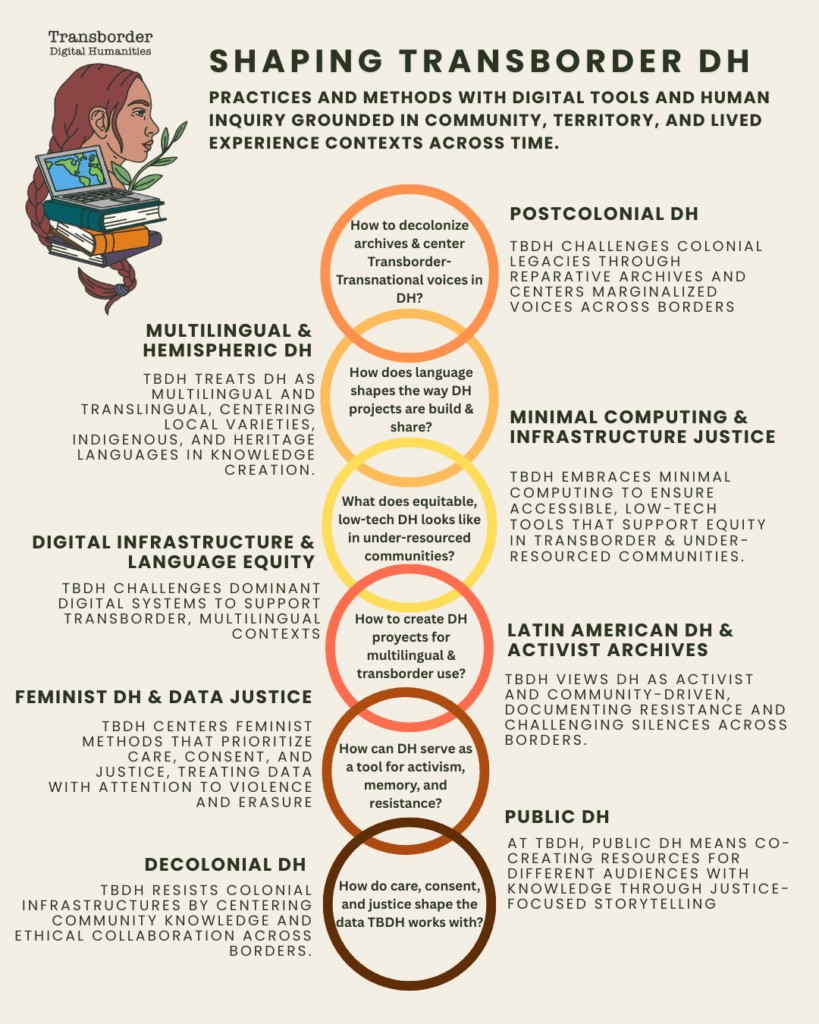
The Transborder Digital Humanities (TBDH) initiative is a Mellon Foundation-funded project that fosters community-engaged research and collaboration on transborder and borderlands cultures. We focus on the U.S.-Mexico border and transborder experiences across the Americas. TBDH supports scholars at all levels–especially first-generation and international researchers–through mentorship, community building, engagement of digital resources, and public scholarship. Our work is rooted in community-engaged critical border studies, ethnic and race studies, heritage language and translingual studies, gender and sexuality studies, and digital and public humanities.
By bringing together interdisciplinary researchers, educators, and community partners, TBDH seeks to expand ethical and responsible approaches to representing border stories in the digital cultural record. Our work is grounded in a commitment to social justice, inclusion, and community collaboration. Our goal is to ensure border narratives are represented with care, accuracy, and respect for the lived experiences of those who navigate borderlands, as well as for those who are not familiar with the borderlands.
Our History
TBDH emerged from a group of humanities and independent scholars that in 2019 came together to discuss the development of a transnational-transborder digital directory of transborder digital production, as a way to document projects and materials that represent the borderlands or narrate digital stories from multiple views using various digital technologies and tools. This idea materialized into the project United Fronteras (UF). The first phase of the project was centered in the Mexico-United States borderlands from pre-colonial times to the present, thus covering a geographical region that has been altered severely due to different geopolitical establishments. Phase one of the UF directory compiled active, inactive, and in development projects and digital materials from both sides of the border creating a third digital space (Fernandez et al, 2022) that shows a variety of cultures, histories, and representations of this border region, the various forms of digital technologies and tools uses and highlights the missing and/or silenced voices and representations of this region in the digital cultural record.
United Fronteras was developed in a non-hierarchical collaborative structure where each of the team members contributed with their knowledge, academic and personal expertise, and skills, while also learning new practices and tools. Considering the geographical landscape of UF, the use of minimal computing seemed necessary as a transborder model to document cultural digital heritage employing technology to bridge the Global North and South taking into consideration its inequities, differences and similarities. UF emerged from the necessity to bring together diverse voices and experiences from the border and to find possibilities to work together and situate UF team and community members as knowledge producers in the cultural digital record.
In the summer of 2021, the United Fronteras team organized the first binational digital humanities symposium that aimed to amplify work done about/on the Mexico-U.S. utilizing digital technologies with a humanities lens. The event was an initial conversation with project creators and people committed to social justice in this region to intervene in the colonial structure of the analog and digital cultural record. In the case of the Mexico-US border region, numerous DH projects with an emphasis on social justice and activism have been generated from both sides of the border; several of those have been compiled in the UF digital directory.
The symposium made space for a dialogue to understand the current state of the field and highlighted necessary and urgent collaborations and infrastructures to amplify border experiences. The binational symposium was held virtually as a result of the pandemic, but also to connect people from both sides of the border, as well as other presenters and attendees from other parts of the world. The panels varied in topics, such as social justice, border activism, digital art, pedagogies and mapping transborder communities. During the creation of the UF transnational-transborder directory, and throughout the two-day Symposium, the UF team was able to learn more about these efforts and work and the impact they have had within different communities along the Mexico-U.S. border and around the world, as well as the limitations and challenges they have faced collecting data, making data accessible, and the sustainability of the projects.
Borderlands and
Positionality
At TBDH, we recognize borderlands as dynamic spaces shaped by histories of migration, colonialism, resistance, and cultural exchange. We engage with borderlands beyond geographic boundaries, understanding them as sites of identity, power, and contestation.
Our work acknowledges that every researcher, educator, and collaborator brings their own positionality–their social, cultural, and historical perspectives–to the study of borderlands at the intersection of digital and public humanities. We encourage critical reflection on these positions and their impact on research, storytelling, and digital representation.
Language Use
Language is central to our work, and we are intentional about the linguistic choices we make in our materials and communications. The events, conferences and communication materials use language that reflects the fluid communication practices of our communities.
By fostering multilingual and translingual engagement and honoring diverse linguistic traditions, TBDH seeks to be an inclusive space where all participants can collaborate across linguistic and cultural boundaries. We welcome all who share our commitment to ethical and community-centered research to join us in shaping the future of transborder digital humanities.