
About the LACDH-TBDH 2026 Symposium
Overview
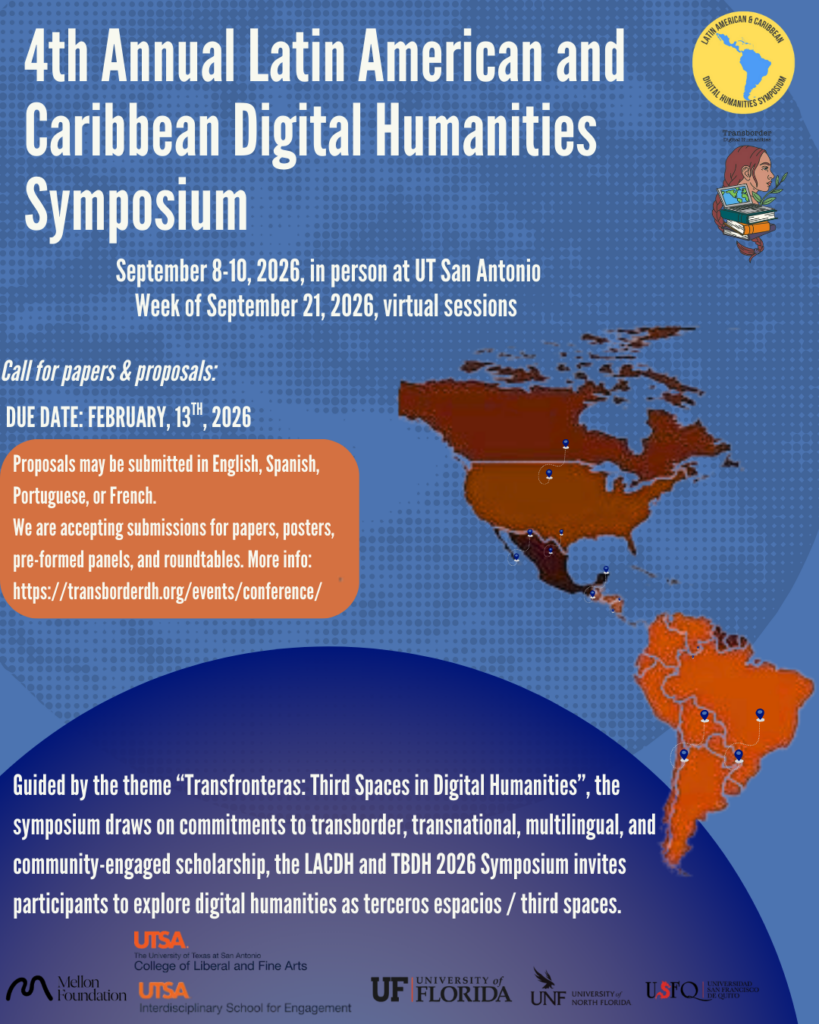
The University of Florida, the University of North Florida, the Universidad San Francisco de Quito, and the Transborder DH Center and Consortium (TBDH) at the University of Texas San Antonio (UTSA) will host the fourth annual Latin American & Caribbean Digital Humanities Symposium from September 8-10, 2026, in person at UT San Antonio. The symposium will also offer virtual sessions the week of September 21, 2026.
For more information visit the Symposium site: https://guides.uflib.ufl.edu/lac-dh-symposium/about
2026 CFP
We seek proposals for papers, pre-formed panels with 3-4 speakers, roundtables of up to 6 participants, and posters related to our conference theme, “Transfronteras: Third Spaces in Digital Humanities” focused on Transborder Digital Humanities, or topics related to Digital Humanities on Latin America and Caribbean Studies. We welcome proposals from higher education (students, faculty, staff, and independent scholars) and encourage projects from cultural institutions and organizations doing work in the digital humanities. We encourage proposals for projects at any stage of completion.
Proposals may be submitted in English, Spanish, Portuguese, or French by FEBRUARY 13, 2026, using the submission form. We are accepting submissions for papers, posters, pre-formed panels, and roundtables.
- Papers and Posters: Please submit an abstract of no more than 250 words.
- Pre-formed panels (3-4 speakers): Please submit the following materials together in one proposal (Max 1000 words total):
- Description of the overall panel
- Abstracts for each of the presentations within the panel. Include presentation title, presenters’ name and their email.
- Moderator’s name and their email
- Roundtables (up to 6 participants): Please submit no more than 750 words describing the overall theme and objectives of the session as well asthe names and emails of all the roundtable participants and moderator.
Participation limit: An individual may appear twice on the program, once as a presenter of a poster or paper (submitted individually or as part of a pre-formed panel) and once on a round table. Serving as moderator does not count toward participation limits.
About Transborder DH at University of Texas San Antonio
Transborder Digital Humanities (TBDH) is a Center and Consortium focused on community-engaged digital research, teaching and collaboration about borderlands within transborder and transnational contexts. This is a Mellon Foundation–funded initiative housed in the Interdisciplinary School of Engagement in the College of Liberal and Fine Arts at UT San Antonio, in partnership with scholars and librarians in various centers and institutions across the Americas.
TBDH supports scholars at all levels through mentorship, training, digital resources, and collaborative exchange. The transdisciplinary group is grounded in multiple areas, including:
- Critical border-transborder studies
- Translanguaging and heritage-language studies
- Ethnic and race studies
- Gender and sexuality studies
- Responsible computing and data science
- Digital media and digital humanities
- Library and Information studies
By bringing together interdisciplinary researchers, educators, librarians, archivists and community partners, TBDH advances ethical and responsible approaches to representing border stories in the digital cultural record.
Digital Humanities as a Third Space/Tercer Espacio
Building on these commitments and the need to continue and amplify the dialogue, the Latin American and Caribbean Digital Humanities (LACDH) and Transborder Digital Humanities (TBDH) 2026 Symposium—guided by the theme Transfronteras: Third Spaces in Digital Humanities—invites participants to reflect on and discuss digital humanities as terceros espacios / third spaces. Border feminist scholar Gloria Anzaldúa (1987) describes the borderlands as a liminal and hybrid space produced through the meeting of different cultures and identities—an in-between zone where new meanings emerge, where those living at the margins can find belonging, and where dominant narratives can be challenged and transformed. Similarly, her concept of nepantla, understood as a “lugar de en medio,” names a state of transition and ambiguity experienced at geographic, cultural, and identity borders. Rooted in a Náhuatl term, Anzaldúa reinterprets nepantla as a transformative liminal space crucial to the formation of new identities.
Understanding digital humanities as a third space—as nepantla—allows us to recognize a wide range of collaborative efforts across disciplines, cultures, skills and knowledges, languages, communities, and geographies. These efforts have created counter-spaces and alternative models: communities, teams, projects, and ideas within and beyond academia that respond to contest, and challenge dominant narratives. Attentive to local, transborder, transnational, and personal borders, we welcome reflections on work shaped by adversity, mistakes, failures, violence, rupture, and change, and on how such moments become sites for navigating borders through inquiry, creativity, transgression, and transformation.
We embrace the slow, the incomplete, and the pause as productive practices that connect, nourish, and cultivate workflows integrating the humanities and the digital in pursuit of more just and livable worlds. This year’s theme encourages contributors to share lessons learned about transborder digital humanities as commitment, as impact, and as ongoing collaboration with individuals, communities, and teams across borders in times of continual evolution.
For this symposium, we welcome contributions on topics including but not limited to:
- Multilingual-Translingual work
- Multicultural-intersectional representations
- Counter-narratives/data/archives/mapping
- Technology disobedience-sovereignity
- Responsible computing, ethics and policy
- Human-computer interactions
- Digital-political-social threats
- Resourcefulness, creativity and ingenuity practices and methods (rasquachismos/border rasquache)
- Collaborations across nations, communities, individuals
- Transnational solidarities
- Feminist digital resistances
- Shared, connected, dispersed, relational digital structures
- Acts of care, healing, justice, repair, slowing down, revising
- Transdisciplinary-Interdisciplinary pedagogies
- Memory-work
- Local cultural heritages
- Fluidity, mobility, transitions, displacement, migration, division scenarios
- Personal, geopolitical, natural borders
How to Submit a Proposal!
La convocatoria también está disponible en español.
L’appel est également disponible en français.
A chamada também está disponível em português.
Proposals may be submitted in English, Spanish, Portuguese, or French by January 31, 2026 using the submission form.
Please contact Sarah Tew (sarahetew@ufl.edu), Hélène Huet (hhuet@ufl.edu) or Sylvia Fernandez (sylvia.fernandez@utsa.edu) for any questions.
2026 Symposium Organizers
Standing Committee
- Hélène Huet, University of Florida
- Melissa Jerome, University of Florida
- Clayton McCarl, University of North Florida
- Anne Pfister, University of North Florida
- Sarah Tew, University of Florida
- Giulianna Zambrano, Universidad San Francisco de Quito
Transborder DH Team
- Sylvia Fernández Quintanilla, PI/Team Lead, University of Texas at San Antonio
- Stephanie Gonzalez, University of Texas at San Antonio
- Sylvia Mendoza, University of Texas at San Antonio
- Elisa Castro, University of Texas at San Antonio
- Jessica Corona, University of Texas at San Antonio
- Carolina Alonso, Fort Lewis College
- Maira Álvarez, University of Toronto
- Laura Gonzales, University of Florida
- Brian Rosenblum, University of Kansas